
We are currently living through one of the most ambitious eras of infrastructure development in human history. To transition the global electrical grid toward renewable energy, massive offshore wind farms are being erected in some of the most hostile oceanic environments on the planet.
When we look at a modern offshore wind turbine, our eyes are naturally drawn to the sleek, aerodynamic blades slowly carving through the air. These structures are staggering in their scale; a single modern turbine blade can measure over 100 meters long—longer than an American football field—and weigh upwards of 50 tons.
While the aerodynamic design and the power-generating turbines get most of the public’s attention, the hidden, unsung miracle of wind energy is the logistics required to actually build the things. The most dangerous phase of a turbine blade’s lifespan is not spinning in a Category 3 hurricane; it is the brief, terrifying window when it is lifted from a transport vessel and hoisted hundreds of feet into the air.
During this lift, a single misunderstanding of physics can cause a multi-million-dollar blade to snap in half before it ever generates a single watt of power.
The Compression Problem
To understand why lifting a turbine blade is so difficult, you have to understand how crane rigging actually interacts with gravity.
Imagine you are trying to lift a very long, delicate sandwich off a table using a single string. If you tie the ends of the string to the far edges of the sandwich and pull up from the middle, the string forms a triangle. As you lift, the tension in the string pulls upward against gravity, but the steep angle of the string also creates a massive horizontal force that pushes inward. The sandwich immediately buckles and folds in half, crushed by the inward compression.
Standard crane rigging works the exact same way. If a crane operator attaches two long wire rope slings from a single crane hook down to the two ends of a massive turbine blade, the upward lift creates a terrifying amount of inward compressive force.
While turbine blades are incredibly strong against the forces of the wind, they are fundamentally hollow shells constructed from layers of fiberglass, carbon fiber, balsa wood, and epoxy resin. They are designed to bend and flex longitudinally, but their hollow sidewalls are incredibly fragile when subjected to lateral compression. If lifted with a standard triangular sling configuration, the inward crushing force of the rigging would instantly cause micro-fractures in the composite shell, compromising the structural integrity of the blade permanently.
Engineering a Zero-Compression Lift
To prevent this catastrophic buckling, mechanical engineers and riggers must completely alter the geometry of the lift. They have to eliminate the “triangle.”
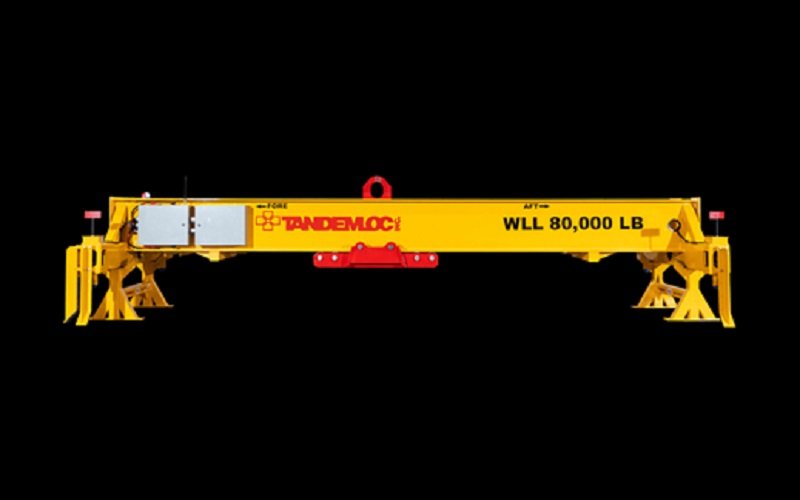
The only way to eliminate the inward compressive force is to ensure that the slings connecting to the fragile blade drop perfectly straight down, perfectly perpendicular to the load. To achieve this, the rigging team introduces a massive, heavily engineered piece of intermediate hardware between the crane hook and the turbine blade.
By utilizing a rigid, heavy-duty load spreader, the crane lifts a solid steel beam high above the blade. The inward crushing forces generated by the angled upper slings are absorbed entirely by this indestructible steel beam. From the ends of this beam, the lower slings drop perfectly straight down to the delicate fiberglass blade below. The compressive forces are neutralized, allowing the blade to be hoisted gently into the air without being squeezed to death.
The Puzzle of Extreme Asymmetry
However, neutralizing compression is only the first half of the battle. The second half is the terrifying puzzle of the center of gravity.
If you are lifting a perfectly symmetrical steel pipe, finding the balance point is easy: it is exactly in the middle. You place your lifting straps equidistant from the center, and the pipe lifts perfectly level.
A wind turbine blade is arguably one of the most asymmetrical objects ever manufactured. The “root”—the circular base that bolts into the hub of the turbine—is dense, thick, and incredibly heavy. The tip of the blade tapers off into a paper-thin, lightweight edge. Because of this extreme asymmetry, the center of gravity is nowhere near the physical center of the blade; it is shifted drastically toward the root.
If a rigging crew simply attached their slings 20 feet from each end of the blade and signaled the crane to lift, the massive weight of the root would instantly drag the back end down. The blade would tip vertically, slide out of the nylon lifting straps, and plummet back to the deck of the ship.
Before a lift ever occurs, engineers use complex 3D modeling to calculate the exact center of gravity for that specific blade design. The lifting hardware must be meticulously adjusted—sliding the lift points asynchronously along the beam—so that the master crane hook sits flawlessly over that invisible, off-center balance point. Only then will the 100-meter blade float level in the air.
Defying the Elements
Finally, all of this flawless geometry must be executed in the middle of the ocean. The crane is mounted to an installation vessel that is constantly pitching and rolling with the ocean swells. Meanwhile, the massive surface area of the 100-meter blade acts exactly like a giant sail. Even a moderate 15-knot ocean breeze will try to spin the suspended blade out of control, threatening to smash it into the tower of the turbine.
To combat this, the lifting hardware is often equipped with active, motorized taglines and internal gyroscopes that constantly fight the wind, allowing the installation crew to rotate the blade with millimeter precision until the bolts align perfectly with the hub.
The transition to a green-energy future relies on brilliant scientists and aerodynamicists, but their designs would be useless without the people operating in the physical world. The true magic of wind energy happens on the deck of a rolling ship, where riggers and mechanical engineers use geometry, heavy steel, and a deep respect for gravity to place the impossible exactly where it needs to be.