
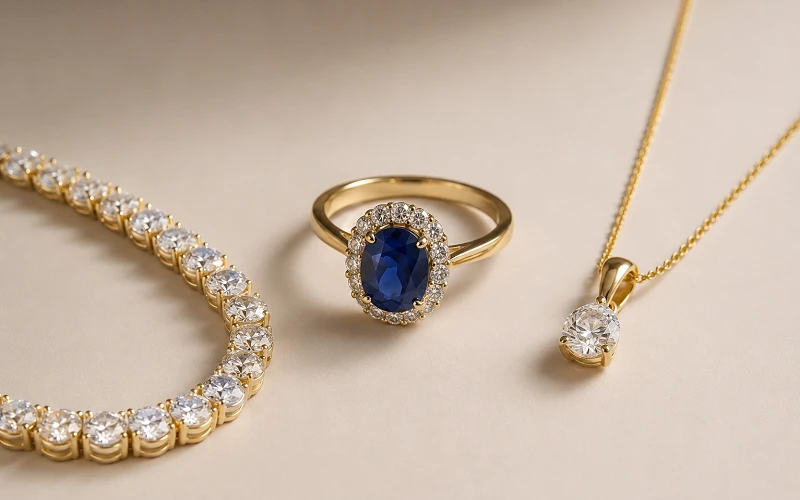
Scottsdale has quietly become one of the most active markets in the country for investment-grade jewelry, attracting buyers who want assets they can hold, store, and eventually sell.
The city’s combination of affluent residents, a mature luxury retail scene, and a culture comfortable with alternative assets has created fertile ground for this shift. What was once considered purely decorative is now being evaluated with the same seriousness as a stock portfolio.
Why Tangible Assets Are Gaining Ground
The appeal of physical assets has grown steadily among investors who have watched digital markets swing without warning. Jewelry occupies a unique position in this conversation because it carries both intrinsic material value and cultural weight. A piece set with certified diamonds or rare colored gemstones holds value tied to the underlying stones and metal, not to a platform or a balance sheet entry.
This matters in Scottsdale because the buyer base here is sophisticated. Many residents already have exposure to real estate, private equity, and commodities. Jewelry fits naturally into that mix as a portable, private, and aesthetically functional asset. No brokerage account required. It travels with the owner and can be liquidated through multiple channels.
The category also benefits from scarcity. Fine gemstones are finite resources, and certain categories, particularly natural unheated rubies, Colombian emeralds, and Kashmir sapphires, have seen consistent demand from collectors and institutions alike. That scarcity creates a floor that manufactured goods cannot replicate.
What Makes Jewelry “Investment Grade”
Not all fine jewelry qualifies as a serious investment vehicle. The distinction matters, and buyers who ignore it often find themselves holding beautiful pieces with limited resale traction.
Certification and Provenance
Gemstone certification from recognized laboratories is non-negotiable for investment-grade pieces. A stone accompanied by a credible grading report carries transparent documentation of its color, clarity, cut, and origin. Origin matters more than many buyers initially realize. A natural ruby from a historically significant source commands a premium that a comparable stone from a different region does not.
Provenance adds another layer. Pieces with documented ownership history, especially those connected to notable estates or auction records, tend to perform better at resale. A single auction result from a major house becomes part of that piece’s permanent record, and serious buyers track that history closely.
Metal and Construction Quality
The setting matters beyond aesthetics. High-karat gold and platinum retain intrinsic melt value, which provides a baseline even if the market for a specific piece softens. Well-constructed settings from recognized makers, whether estate pieces from established European houses or contemporary work from respected bench jewelers, add craftsmanship value that mass-produced jewelry simply cannot claim.
Buyers in Scottsdale’s investment market tend to gravitate toward signed pieces, meaning jewelry bearing a maker’s mark from a house with a recognized name. These pieces carry brand equity that functions similarly to a label in the watch market.
The Scottsdale Ecosystem for Jewelry Investment
Scottsdale’s infrastructure for buying and selling investment jewelry is more developed than most cities its size. The concentration of estate dealers, auction specialists, private brokers, and high-end consignment galleries gives buyers real options at every stage of ownership.
Several dynamics make this market distinct:
- Estate inventory depth: The region’s aging affluent population generates consistent estate jewelry supply, creating opportunities to acquire quality pieces at prices below new retail.
- Auction access: Local and regional auction houses handle significant jewelry consignments, and national houses regularly hold preview events in the area.
- Private dealer networks: Many transactions happen quietly through dealer-to-dealer channels, bypassing public listings entirely.
- Collector community: A visible community of serious collectors creates a peer market for direct sales and trades.
- Retail sophistication: High-end jewelers in the area are accustomed to buyers asking investment-oriented questions, which shifts the conversation toward documentation and resale history rather than just design.
This infrastructure reduces friction for buyers who want to move in and out of positions over time. Liquidity is always a concern with physical assets, and Scottsdale’s ecosystem addresses that more effectively than smaller or less specialized markets.
Understanding Resale Dynamics Before Buying
One of the most common mistakes new jewelry investors make is treating the purchase price as the baseline for future returns. The retail markup on new jewelry is substantial, which means a piece bought at full retail from a brand boutique faces a significant gap before it reaches resale territory. That gap has to be closed before any appreciation means anything.
The smarter entry point for investment purposes is often the secondary market, where estate pieces and private acquisitions sourced through auctions, collectors, and trusted Scottsdale jewelers like ED Marshall can offer buyers access closer to true market value. Estate pieces, auction acquisitions, and private sales from motivated sellers allow buyers to enter closer to actual market value. From that starting point, appreciation becomes a realistic possibility rather than a mathematical obstacle.
Resale channels also deserve attention before buying. A piece that moves easily at auction may be harder to sell through a private dealer, and vice versa. Understanding where comparable pieces have sold, and at what price relative to their last acquisition cost, gives buyers a realistic picture of what to expect when the time comes to exit.
Condition management is part of this equation. Investment jewelry should be worn carefully or stored properly. Stones can chip, prong settings wear down, and surface finishes change over time. A piece in excellent original condition consistently outperforms one that shows heavy wear, even when the underlying stones are identical.
How Buyers Are Approaching the Market Right Now
The current environment in Scottsdale reflects broader trends in how affluent individuals think about wealth preservation. There is growing interest in assets that exist outside traditional financial systems, and jewelry fits that profile cleanly. It is private, portable, and not subject to the same reporting requirements or institutional dependencies as securities.
Buyers are also becoming more educated. The availability of gemological information, auction archives, and dealer price histories means that informed buyers can evaluate pieces with real precision. This has raised the standard for sellers and pushed the market toward greater transparency overall.
Colored gemstones have drawn particular interest. For years, diamonds dominated the investment jewelry conversation, but fine rubies, sapphires, and emeralds have attracted attention from buyers looking for categories with strong collector demand and limited supply. The rarest examples of these stones have proven resilient across different economic conditions, which appeals to buyers prioritizing capital preservation.
Then there is the renewed interest in signed vintage pieces from the mid-twentieth century. Jewelry from recognized European houses produced during that era combines craftsmanship, historical significance, and brand recognition in a way that contemporary production cannot easily replicate. Scottsdale’s estate market surfaces these pieces regularly, and buyers with the knowledge to identify them have found consistent opportunities.
The Takeaway
Scottsdale’s investment jewelry market reflects a broader rethinking of what wealth preservation looks like in practice. Tangible assets with documented value, genuine scarcity, and multiple resale channels offer something that purely financial instruments cannot: physical certainty.
Buyers who approach this market with the same discipline they apply to other investments, studying provenance, understanding resale dynamics, and entering at realistic price points, are well positioned to build meaningful positions over time. The market rewards knowledge. And in Scottsdale, the knowledge base is growing.