
In the global theater of logistics and industrial manufacturing, the standard 20-foot and 40-foot ISO container is a symbol of modular uniformity. It is a structure designed to stack perfectly, secure effortlessly, and move seamlessly from ocean liners to railcars to flatbed trucks. Because the exterior dimensions of these containers are rigidly standardized, there is a dangerous tendency among crane operators and rigging crews to assume that the internal physics of the load are uniform as well.
This assumption is one of the most hazardous illusions in the heavy-lift industry. While the steel box itself is symmetrical, the cargo housed inside is frequently anything but. Whether a container is packed with heavy industrial machinery, asymmetrical power units, or liquid bladders prone to shifting, its true Center of Gravity (CG) is rarely resting perfectly in the geometric center. When an overhead crane hooks onto an off-center load using standard, fixed rigging, the laws of classical physics convert that hidden imbalance into a cascade of destructive kinetic forces.
The Physics of the Dangerous Tilt
To understand why an asymmetric center of gravity is so destructive, one must analyze the mechanical behavior of a suspended object. When a crane hoists a load, the total mass will naturally shift in mid-air until the true center of gravity positions itself directly, vertically beneath the primary crane hook point.
If the load is perfectly balanced, it rises completely level. However, if the CG is offset toward one side or one end of the box, the structure will undergo an immediate, unmitigated rotation as soon as it leaves the ground. One end drops violently while the other rises, tilting the entire container at a severe angle.
[Balanced Load] –> Vertical Hoist Line –> Uniform Tension across all 4 Corners
[Asymmetric CG] –> Dynamic Tilting –> Shock Loading on Low-Side Twistlocks
This sudden tilt introduces an array of immediate mechanical failures. First, it forces the crane’s wire ropes or chain slings into highly uneven angles of tension. The legs of the rigging closest to the heavy side of the load absorb an immense share of the weight, routinely exceeding their engineered Working Load Limit (WLL). Concurrently, the rigging legs on the high side experience a sharp drop in tension, causing them to go slack or suffer from catastrophic slippage. This unequal load distribution passes extreme bending and twisting forces straight into the crane’s boom, tracking rails, and internal hoist brakes, risking an immediate structural failure of the entire crane mechanism.
The Threat of Shock Loading on Twistlock Interfaces
The secondary and often more immediate threat of an unbalanced container lift occurs at the interface between the lifting frame and the container’s corner castings. Standard container rigging relies on heavy-duty steel twistlocks that insert into the oval apertures of the container’s corners, turning 90 degrees to lock the two structures together.
When a container tilts severely due to an off-center CG, the uniform distribution of weight across all four corner castings is destroyed. The two twistlocks on the lower, heavier side of the tilt become massive fulcrums, bearing nearly the entire weight of the payload. As the load swings or encounters wind resistance in mid-air, it experiences dynamic shock loading.
Because steel possess a finite threshold for sudden, localized stress spikes, this concentrated tension can shear the twistlock pins or fracture the cast-iron corners of the container. If a single twistlock fails under this extreme pressure, the remaining connections yield instantly, dropping multi-ton payloads from mid-air. This results in the absolute destruction of expensive components, terminal facilities, and any ground crews working within the drop zone.
Introducing Motorized Leveling to Neutralize the Offset
Preventing these dynamic rigging disasters requires moving past manual, trial-and-error balancing methods. Expecting ground crews to manually adjust chain shorteners or weld counterweights to a heavy structural box before a lift introduces a massive amount of operational downtime and puts workers in high-risk zones beneath a suspended load.
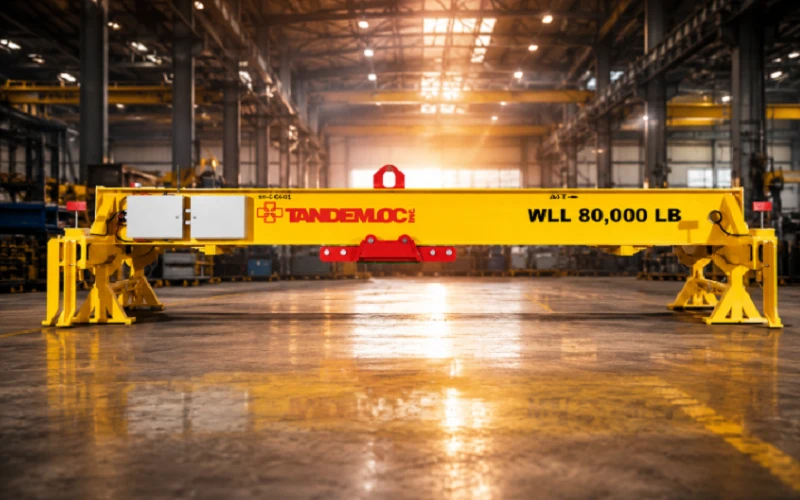
True structural safety demands a smart, proactive below-the-hook device engineered to dynamically shift its internal suspension architecture to match the precise location of the offset CG. This level of mechanical adaptability is achieved by utilizing heavy-duty, battery-powered container lifting frames equipped with automated or remotely controlled load-leveling capabilities.
[Fixed Lifting Frame] –> Asymmetric CG –> Severe Tilt –> High-Side Slack / Low-Side Shear
[Intelligent Lifter] –> Adjusts Bail –> Level Lift –> Evenly Distributed Corner Tension
In high-capacity environments where structures matching container profiles must be handled with absolute precision, utilizing an advanced motorize load spreader frame completely redefines the safety margins of the operation. By implementing an onboard, battery-driven motorized system that slides the primary lifting bail along the length of the frame under full load, the operator can align the crane hook directly over the true center of gravity in real time.
As the motorized mechanism shifts the lifting point up to several feet along the frame’s axis, the container remains perfectly horizontal throughout the entire duration of the lift. This absolute leveling ensures that the tension is shared equally across all four corner twistlocks, completely eliminating the extreme lateral shear forces that cause structural deformation and unexpected failure.
The Operational Dividend of Safety Automation
In 2026, terminal efficiency and industrial safety are no longer viewed as competing goals. They are the twin pillars of sustainable, high-volume production. Relying on outdated rigging tactics that force crane operators to guess the balance point of a closed container is an unmitigated liability that modern operations cannot afford to absorb.
Investing in intelligent, below-the-hook lifting technology that features wireless remote control, motorized locking mechanisms, and continuous level-under-load capability is a proactive strategy for long-term operational resilience. It completely removes ground crews from the line of fire, cuts down hook-to-unhook cycle times, and insulates high-value infrastructure from the destructive physics of asymmetric weight distribution. True engineering dominance isn’t merely about building a bigger crane; it is about deploying the exact mechanical intelligence required to neutralize the hidden imbalances of the loads you lift.