
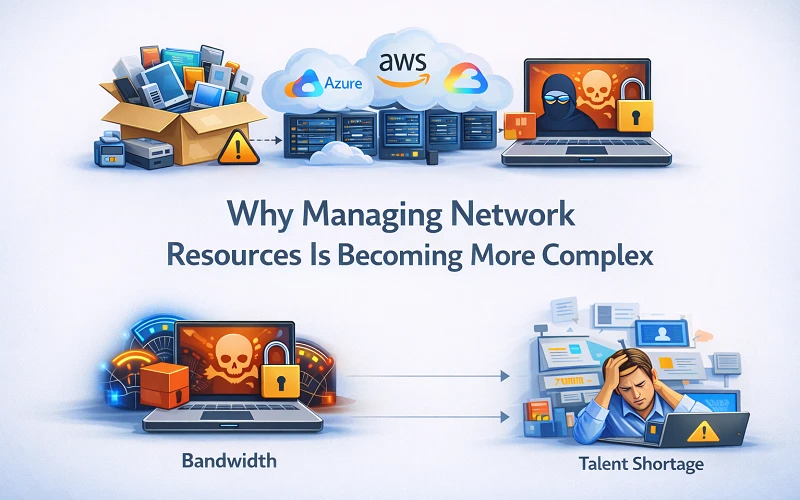
10 years ago, a network admin could pretty much sketch the entire company infrastructure on a whiteboard. A few servers in a closet, some desktop machines, maybe a firewall that needed attention once a quarter. Those days are gone.
Now? IT teams are drowning. They’re managing thousands of devices across multiple cloud platforms while remote workers connect from coffee shops in twelve different time zones. And the security threats just keep getting nastier.
Too Many Devices, Not Enough Hands
Gartner’s prediction of 25 billion connected devices by 2025 probably lowballed it. Every employee brings a phone, a tablet, maybe a smartwatch. The office has IoT sensors in the HVAC system. Someone installed a smart coffee maker that technically touches the network.
IT departments tracking 500 assets a decade ago now handle 5,000 or more. Staffing levels? Mostly unchanged. The math doesn’t work, but somehow teams make it happen through caffeine and automation scripts held together with duct tape.
BYOD policies made things worse. One developer might connect through a company MacBook at headquarters, a personal iPad at home, and an Android phone while grabbing lunch. Each connection needs monitoring. Each one could be compromised.
Hybrid Cloud Is a Headache
Pure on-prem is dead for most companies. Pure cloud isn’t practical either. So everyone runs this awkward hybrid setup with workloads split between AWS, Azure, Google Cloud, and that legacy data center nobody wants to touch but can’t afford to migrate.
Keeping track of traffic across all these environments is genuinely painful. Many organizations now use a proxy manager to route and monitor connections between their scattered infrastructure. Without something coordinating the chaos, requests get lost, latency spikes randomly, and security teams can’t see half of what’s happening.
Mergers make everything worse. Two companies with completely different cloud setups suddenly need to work together. According to Harvard Business Review, failed technology integration ranks among the top reasons acquisitions don’t deliver expected returns.
Security Eats Everything
Ransomware attacks jumped 95% in 2023. The criminals don’t care if you’re a Fortune 500 company or a 50-person accounting firm. They’ve automated their tools to hit everyone.
Network admins now spend something like 40% of their week on security tasks. That’s time pulled away from performance tuning or planning upgrades. Everyone’s stuck in permanent firefighting mode.
Zero-trust architecture is supposed to help, but actually implementing it is brutal. The National Institute of Standards and Technology published a 50-page guide just covering the concepts. Real-world deployment means hundreds of configuration choices, and getting one wrong can lock out legitimate users or leave holes for attackers.
Bandwidth Wars
Video calls alone consume 10 to 20 times the bandwidth of voice. Put 1,000 employees on Zoom at once and watch the network buckle. Most infrastructure wasn’t built for this.
Large file transfers, collaboration tools, and streaming media all fight for the same connections. Old quality-of-service rules that prioritized email don’t help when every application claims to be mission-critical.
Edge computing takes some pressure off by processing data closer to users. But here’s the catch: edge deployments need their own monitoring, updates, and security patches. You’re solving complexity by adding more complexity.
Nobody Can Find Good Engineers
Hiring qualified network staff has become a nightmare. Wikipedia documents a global shortage of nearly 4 million cybersecurity professionals. That’s not a typo.
Companies throw money at candidates, positions sit empty for months, and junior people get promoted before they’re ready. Mistakes happen. Configurations get botched. Security gaps open up because someone didn’t know what they didn’t know.
Automation tools and AI-powered monitoring can help bridge the gap. But deploying those tools correctly requires expertise that’s equally hard to find. It’s a frustrating loop.
Where This Goes
Network complexity isn’t going to fix itself. The organizations getting through it are investing in unified platforms, automating aggressively, and training the staff they already have instead of waiting for perfect hires who may never show up.
The ones struggling most still treat network management like a cost to minimize rather than a function that keeps the business running. With downtime averaging $5,600 per minute, that attitude has real consequences.