
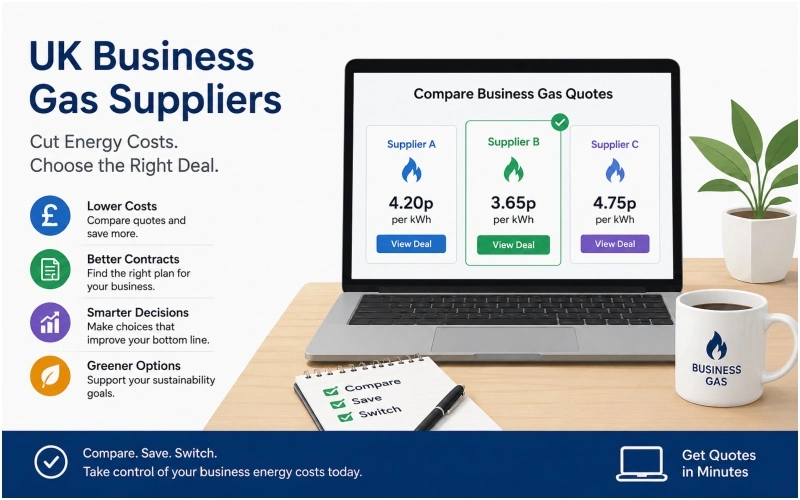
Most UK business owners can recite what they pay for rent, payroll, and software. Ask them what they pay per kilowatt hour for gas, and the answer is usually a shrug. That gap is where a lot of margin quietly disappears. Business gas used to behave like a fixed overhead. The supplier sent a contract, the contract rolled at the end of its term, and the operator paid the new rate without revisiting the assumptions behind it. Over the last few years that pattern has broken. Wholesale gas prices settled into a new and higher baseline, contract structures have grown more varied, and the gap between the cheapest and most expensive tariff available to the same business on the same day has widened to the point that inertia is genuinely expensive.
For SME owners and finance leads who already negotiate hard on every other line of the profit and loss statement, the next gas contract is now a procurement decision rather than a default direct debit.
The hidden cost of doing nothing
Three forces sit behind the shift.
Wholesale volatility. Gas prices in the UK have settled at a higher baseline than the pre-2022 era, but they still move. A contract signed during a market peak locks in costs that the same business could have avoided by waiting. A contract signed at the bottom of a cycle locks in savings. Timing matters in a way it did not when prices moved in narrower ranges.
Out-of-contract rates. When a fixed-term contract ends without a renewal in place, the supply rolls onto a deemed or out-of-contract tariff. These rates are almost always significantly higher than the original deal and apply automatically until the customer takes action. A meaningful share of UK SMEs sit on these rates without realising it.
Non-commodity costs. Standing charges, distribution costs, climate change levy contributions, and other fixed components make up a growing share of the total bill. Two quotes with identical unit rates can produce very different annual bills once the full structure is considered.
The cumulative cost of ignoring these factors over a five-year horizon is meaningful for any business operating on standard SME margins.
What a serious gas procurement review covers
A useful review goes deeper than asking the incumbent supplier and two competitors for a quote. Four areas drive the result.
Consumption pattern. Twelve months of usage data shows when the business actually uses gas and whether the current tariff structure fits. A bakery, a hotel kitchen, and a manufacturing line all consume gas in very different shapes, and the right contract reflects that.
Contract structure. Fixed contracts give budget certainty. Flexible and pass-through contracts can be cheaper if wholesale prices fall but expose the business to volatility. The right choice depends on cash flow tolerance, not on what the salesperson prefers.
Non-commodity components. Standing charges, capacity charges, and other fixed items need to be compared alongside the unit rate, not separately.
Green and reporting credentials. Businesses with sustainability commitments need to confirm that the gas product they buy fits their reporting requirements, including any green gas certificates or carbon offset components.
Where a specialist broker fits
For most SME owners, running this kind of review in-house is not realistic. Bills sit in PDF format, contract language is dense, and going to every licensed supplier individually is a full-time exercise. Specialist services such as Utility Bidder compare quotes from multiple UK business gas suppliers in a single process, handle the switching paperwork, and flag the renewal window before the existing contract auto-rolls onto an out-of-contract rate. The value is not just a sharper unit price, it is also the removal of the admin barrier that keeps most operators on the wrong deal for longer than they should be.
A practical workflow for the next renewal
Pull the last twelve months of gas bills for every site.
Note the contract end date and the notice window for each meter point.
Identify the current unit rate, standing charge, and any pass-through items being paid.
Decide whether budget certainty or potential savings matters more for the year ahead.
Request comparison quotes at least three to six months before the renewal window opens.
Even businesses that decide to stay with the existing supplier almost always end up on a sharper rate once the incumbent knows the contract has been tested.
The longer picture
Energy is no longer a passive line item. It is a strategic input that affects pricing, sustainability reporting, and resilience. UK businesses that treat the next gas contract as a procurement exercise rather than admin tend to come out of the year with lower bills, cleaner reporting, and fewer surprises in the following twelve months.
Frequently Asked Questions
Can any UK business switch its gas supplier? Yes. Any non-domestic gas customer in the UK can switch supplier within the notice period in the current contract, which is usually one to six months before the end date.
How long does a business gas switch take? Once a new contract is signed, most switches complete within four to six weeks. The physical supply does not change, only the retailer responsible for billing and customer service.
What is an out-of-contract rate? A higher tariff applied automatically when a fixed-term contract ends without renewal. It is one of the most common causes of SME overpayment on gas in the UK.
Is a fixed or flexible gas contract better? It depends on appetite for risk and the size of the energy spend. Fixed contracts give budget certainty. Flexible contracts can be cheaper if wholesale prices fall but carry volatility. Larger sites sometimes blend both.
Do business utility brokers charge the customer directly? Most reputable brokers are paid commission by the supplier when a contract is signed, not by the business. Under current transparency rules, that commission is disclosed inside the quote.
How often should an SME review its gas contract? At least every twelve months and ideally during the final third of the existing fixed-term contract, so there is time to act before the renewal window closes.
What information is needed to start a comparison? A recent gas bill, the meter point reference number, and the contract end date are usually enough for a specialist broker to begin the comparison.
Can a tenant business switch its gas supplier? In most cases yes, provided the business is the named account holder for the supply rather than the landlord.