
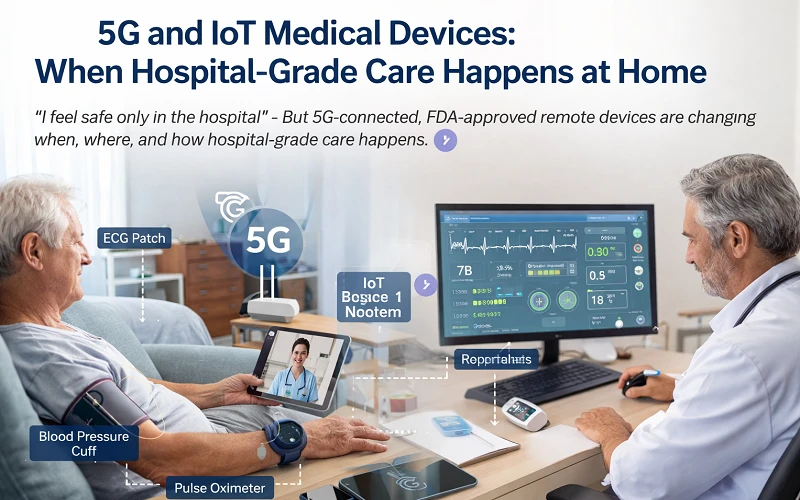
I hear this line all the time: “I feel safe only in the hospital.” I get why. But wards are packed, staff are stretched, and the real danger often hides in the quiet days at home when no one is looking at your vitals. Meanwhile, IoT healthcare solutions are gaining momentum, and with 5G in sync, they help us to stop that blind spot.
Let’s take a closer look at what’s happening in practice.
5G and IoT Medical Devices in Plain Words
When I say “IoT medical device,” I don’t mean a fitness band you bought on sale. I mean approved hardware that your cardiologist can put in a care plan without losing sleep: ECG patches, connected blood pressure cuffs, continuous glucose monitors, smart scales, wound sensors, infusion pumps.
Here’s how I explain the stack when someone asks what all the hype is about:
What the devices do
- Measure hard signals: heart rhythm, blood pressure, oxygen saturation, weight, temperature, glucose trends, local wound changes.
- Push readings on their own; no “I forgot to write it down” drama.
- In some cases, act as well: pumps and hubs can adjust delivery based on orders coming from the clinical system.
What 5G adds on top of Wi-Fi or 4G
- Low latency, so a streaming ECG or video consult does not stutter.
- Strong uplink, so you can send continuous data from several devices in the same home.
- Better support for dense deployments: whole “virtual wards” at home in one city rather than a single device in one flat.
Why the combo matters
- Clinicians see home data with the same confidence they expect in a ward.
- Patients stay in their own space while still being “on the grid” clinically.
Use Case 1 – Chronic Care That Never Switches Off
Every chronic care story I’ve watched up close follows the same sad script. In the clinic, charts look fine. Between visits, heart failure patients gain fluid, COPD patients creep into breathlessness, and diabetes goes wild. The team hears about it when the ambulance has already been called.
With 5G and home devices, you do not change the disease; you change the timing. Problems appear days earlier, when a phone call and a pill tweak still help.
The contrast is stark:
Before connected chronic care
- Patients write numbers in notebooks or basic apps; many never bring them.
- Doctors see snapshots three or four times a year.
- “Sudden” readmissions for fluid overload, flare-ups, or glucose spikes feel like bad luck.
After 5G-enabled monitoring
- At home, you have a small kit: scale, blood pressure cuff, pulse oximeter, sometimes a chest patch or continuous glucose monitor.
- Data streams through a 5G gateway or hub, even when home Wi-Fi is a joke.
- Simple rule sets plus machine-learning models flag patterns: two kilos up in three days, oxygen dropping at night, repeated excursions in glucose.
What changes in real life
- Nurses call early, adjust diuretics, tweak inhaler plans, or book fast reviews instead of waiting for the crash.
- Patients feel watched without feeling trapped in a hospital room.
One heart-failure virtual-care pilot in the UK reported roughly a 50% drop in 30-day readmissions once remote monitoring was tied to an active clinical team, which is huge for both outcomes and costs.
Use Case 2 – Hospital-at-Home and Virtual Wards
The first time I sat in a “virtual ward” control room, the cognitive dissonance was real. On the whiteboard, the list looked like any hospital ward. On the screens, patients were in their kitchens, bedrooms, gardens. On paper, they were admitted. Physically, they were at home.
The setup is simple, but the choreography is tight:
Who lands on a virtual ward
- People who still need hospital-level observation but no longer need a physical bed and constant procedures.
- Often, older patients with infections, heart failure, or post-acute flare-ups, selected with clear risk tools.
What goes to their home
- A hub or tablet that guides them through checks and supports video calls.
- Devices: BP cuff, thermometer, pulse oximeter, sometimes ECG patch, sometimes a pump or oxygen kit.
- A 5G router or modem so devices do not die every time a relative streams video next door.
What happens on the hospital side
- Nurses and doctors watch an exception-based dashboard, not a wall of raw numbers.
- They run “ward rounds” by video or scheduled home visits instead of walking down a corridor.
- Clear rules decide when to send a nurse, paramedic, or ambulance, and when to keep watching.
Use Case 3 – Post-Surgery Recovery and Rehab at Home
Most post-op journeys I hear about still feel analog. You get sent home with a pile of paper, maybe one follow-up date, and a vague line like “call if it looks red or feels wrong”. Surgeons are blind for weeks.
With 5G and IoT, that quiet stretch stops being a black box. It becomes a live feed you can act on.
A realistic setup looks like this:
What you track after surgery
- Wearables capture steps, heart rate, sleep, and sometimes respiratory rate.
- Smart dressings or small sensors near the wound that report local temperature or moisture, which tend to rise before an infection is obvious.
- Short symptom and pain scores inside an app rather than forgotten forms.
How rehab moves online
- Motion sensors on knee braces, shoulder straps, or exercise bands measure range of motion and effort.
- Physios see who is doing their exercises and who is stuck, instead of guessing at the clinic.
How teams act on that data
- If the range of motion plateaus or pain stays high, someone calls to fix pain plans or exercise technique.
- If wound data looks bad, the team brings the person back in early, before major complications hit.
The tech is not the star here. The star is timing: problems caught two days sooner often mean oral antibiotics and reassurance instead of a second surgery.
How Providers Can Start Small With 5G Home Care
Every time a hospital tries to “roll out 5G everywhere”, it stalls. The teams that make progress treat home care like any other serious change: they start narrow, prove value, then grow.
A simple, honest playbook looks like this:
- Pick one clear use case.
- Map the full flow.
- Sort out connectivity.
- Integrate, don’t bolt on.
Pilot, measure, impro